
If your goal is to decrease the development time for new MIG welds, you can do it by calculating starting wire-feed speed, voltage, and travel speed. Pre-calculating is common among manufacturers welding with solid wire or flux-cored wire.
Most welding professionals know how calculating starting wire feed speed (WFS) based on their experience, while beginners usually follow the manufacturer’s recommended procedures.

However, determining the travel speed for a particular size weld bead is an iterative, time-consuming process, meaning costs go up in manufacturing. Understanding a few concepts and doing some math with a few simple formulas can help you at least a good starting point for achieving the desired weld.
Understanding The Deposition Rate
Prior to any calculations, you should know that Deposition Rate is directly proportional to the speed of a particular wire diameter that emerges from a MIG welding gun. On the other hand, deposition rate has nothing to do with travel speed nor the voltage setting on the machine.
The deposition rate simply shows how many pounds of wire come from the welding gun in a particular time. That’s why it is typically measured in lb./hr.
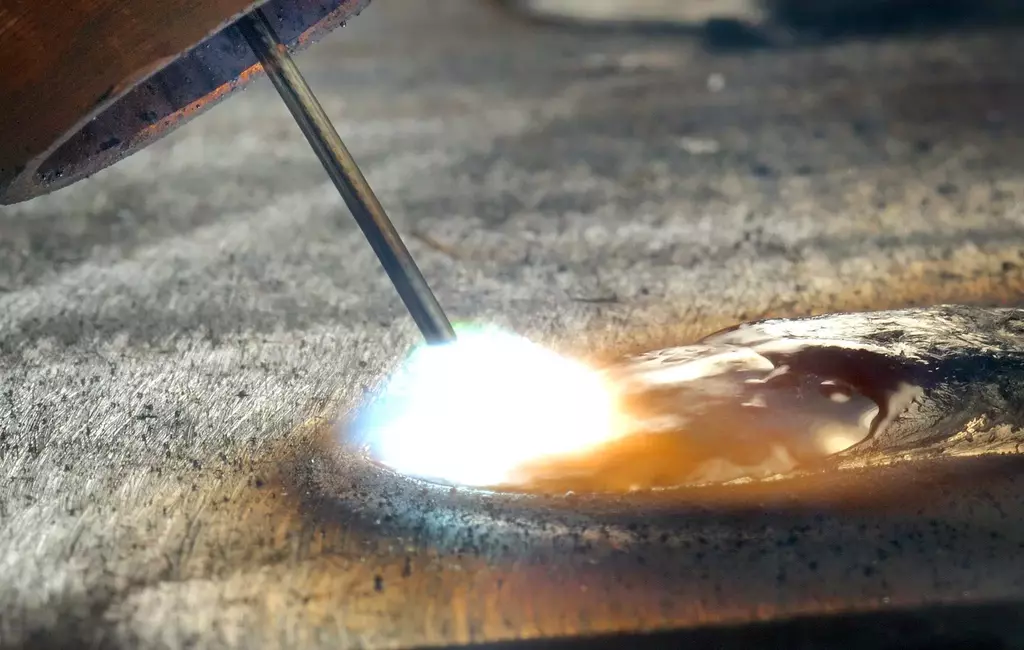
As a result, suppose wire-feed speed increases, and deposition rate increases. Therefore, if you maintain the wire-feed speed and choose a larger diameter wire, the deposition rate will also increase.
By understanding the fundamentals, calculating deposition rate is an effective exercise you can use to get to the critical welding parameters.
Let’s look at the formula and an example:
Deposition Rate Calculation
Deposition rate (lb./hr) = 13.1×(Wire diameter)2×(Wire-feed speed)×(Efficiency)
- Wire diameter in given in inches (in.)
- Wire-feed speed is calculated in inches per minute (IPM)
- Efficiency differs, and it is 1.0 for solid wire, 0.85 for cored wire
- Keep in mind that this calculation is for steel only
For example, if your project requires: Wire diameter = 0.030 in. (1.2 mm) solid wire, WFS = 350 IPM.
Deposition rate = 13.1×(0.030)2 ×(350)×(1.0) = 4.13 lb./hr
Calculating Travel Speed By Using Deposition Rate Results
By getting the deposition rate by using the calculation above, you can calculate the travel speed in inches per minute (IPM) for a particular weld. For example, let’s say you want to make a 3/8-in. steel fillet weld (assume 10% reinforcement or 0.4125 in. leg) using 0.030-in. solid wire at 350 IPM, the weight of weld metal per foot can be calculated by multiplying the density of steel (0.283 lb./in3) by the volume of weld metal per foot as follows:
Calculating Weld Weight Per Foot
Vol. of weld metal/ft=1/2×b×h×12 in.=1/2×0.4125 in.×0.4125 in.×12 in.=1.02 in3.
Weight of weld metal/ft of 3/8 in. fillet weld=(0.283 lb./in3)×(1.02 in3)=0.2887 lb./ft.
Next, we will use weld weight per foot to calculate the travel speed
Calculating Travel Speed
Travel speed = (deposition rate)×(# of passes)/5×(weight of weld metal per foot {lb./ft}) = (4.13)×(1)/5 × (0.2887) = 0.23 IPM
Calculating Wire-feed Speed Using Deposition rate
Let’s assume a requirement to make fillet welds at a rate of 12 lb./hr using 0.030 in. welding wire. Then, we can calculate the WFS using the formulas below and the Weight of Weld Wire per foot in Table 1.
| Wire Diameter (in.) | Weight Of Wire (lb./ft) | Wire Diameter (in) | Weight of Wire (lb./ft) |
|---|---|---|---|
| 0.035 | 0.0033 | 3/32 | 0.023 |
| 0.040 | 0.0043 | 1/8 | 0.042 |
| 0.045 | 0.0054 | 5/32 | 0.065 |
| 0.052 | 0.0072 | 3/16 | 0.094 |
| 1/16 | 0.01 | 7/32 | 0.128 |
| 5/64 | 0.016 |
Wire-feed Speed Calculation
Wire-feed Speed = (deposition rate)/5×(weight of wire per foot {lb./ft}) = (12)/5×(0.0054) = 444.4 IPM
Of course, the travel speed for a one-pass, 3/8 in. fillet weld at a 12 lb./hr deposition rate would be 8.31 IPM, as calculated below.
Travel Speed = (deposition rate)×(# of passes)/5×(weight of weld metal {lb./ft}) = (12)×(1)/5×(0.2887) = 8.31 IPM
Using Simple Methods For Calculating Starting Wire Feed Speed, Voltage, and Travel Speed
The Bartonian Conversion Factor (Table 2) makes things a bit easier for fillet welds. The example below uses the conversion factor to calculate travel speed at 5.57 IPM for that same 3/8 in. fillet weld using a 0.045 in. solid wire.
Travel Speed = 7.96×0.7 = 5.57 IPM (.2887)
| Leg Size (in.) | Weight of Weld Metal Per Foot | B |
|---|---|---|
| 3/16 | 0.072 | 2.7 |
| 1/4 | 0.129 | 1.5 |
| 5/16 | 0.201 | 1 |
| 3/8 | 0.289 | 0.7 |
The weight of weld metal per foot can be calculated for any join type by summing the volume and multiplying by the density of the weld metal (eg. 0.283 lb./in3 for steel). However, the values shown in Table 3 through Table 6 eliminate the need to do the calculation. These values are taken from Table 12-1 in The Procedure Handbook of Arc Welding by the Lincoln Electric Co., showing the Weight of Weld Metal per Foot for several common joint types welded with steel.
The following sample calculations use Tables 3 through 6.
| Plate size (in.) | 1/16 | 1/8 | 3/16 | 1/4 | 3/8 | 1/2 |
|---|---|---|---|---|---|---|
| 1/8 | 0.027 | 0.053 | 0.080 | .106 | .159 | .213 |
| 3/16 | .040 | .080 | .120. | .159 | .213 | .319 |
| 1/4 | .053 | .106 | .159 | .213 | .319 | .425 |
| 5/16 | .066 | .133 | .199 | .266 | .398 | .531 |
| 3/8 | .080 | .159 | .239 | .319 | .478 | .638 |
| 7/16 | .093 | .186 | .279 | .372 | .558 | .744 |
| 1/2 | .106 | .213 | .319 | .4425 | .638 | .850 |
| 3/4 | .159 | .319 | .478 | .638 | .969 | 1.28 |
| 1 | .213 | .425 | .638 | .969 | 1.28 | 1.70 |
| 1 1/2 | .319 | .638 | .956 | 1.28 | 1.91 | 2.55 |
| 2 | .0425 | .850 | 1.28 | 1.7 | 2.55 | 3.40 |
| Plate Size (in) | Flat Weld | Convex Weld | Concave Weld |
|---|---|---|---|
| 1/8 | .032 | .041 | .036 |
| 3/16 | .072 | .093 | .081 |
| 1/4 | .129 | .165 | .145 |
| 5/16 | .201 | .258 | .226 |
| 3/8 | .289 | .371 | .325 |
| 7/16 | .394 | .505 | .443 |
| 1/2 | .514 | .659 | .578 |
| 3/4 | 1.16 | 1.48 | 1.30 |
| 1 | 2.06 | 2.64 | 2.31 |
| Plate Size (in) | 14° | 20° | 30° | 45° | 60° | 70° | 75° | 80° | 90° |
|---|---|---|---|---|---|---|---|---|---|
| 1/8 | .0065 | .009 | .014 | .022 | .031 | .037 | .041 | .045 | .053 |
| 3/16 | .015 | .021 | .032 | .049 | .069 | .084 | .092 | .100 | .119 |
| 1/4 | .026 | .037 | .057 | .088 | .123 | .149 | .163 | .178 | .212 |
| 5/16 | .041 | .058 | .089 | .137 | .191 | .232 | .254 | .278 | .322 |
| 3/8 | .059 | .084 | .128 | .198 | .276 | .334 | .366 | .401 | .478 |
| 7/16 | .080 | .115 | .174 | .269 | .375 | .455 | .499 | .545 | .650 |
| 1/2 | .104 | .150 | .226 | .352 | .490 | .594 | .651 | .712 | .849 |
| 3/4 | .235 | .337 | .512 | .791 | 1.103 | 1.338 | 1.466 | 1.603 | 1.910 |
| 1 | .417 | .599 | .910 | 1.407 | 1.961 | 2.378 | 2.606 | 2.850 | 3.396 |
| 1 1/2 | 0.938 | 1.347 | 2.047 | 3.165 | 4.412 | 5.350 | 5.863 | 6.412 | 7.641 |
| 2 | 1.668 | 2.395 | 3.640 | 5.627 | 7.843 | 9.512 | 10.423 | 11.398 | 13.584 |
| Cap Width (in.) | 1/16 | 1/8 | 3/16 | 1/4 |
|---|---|---|---|---|
| 3/8 | .026 | .053 | .080 | .106 |
| 1/2 | .040 | .080 | .120 | .1559 |
| 3/4 | .053 | .106 | .159 | .213 |
| 1 | .066 | .133 | .199 | .266 |
| 1 1/4 | .080 | .159 | .239 | .319 |
| 1 /12 | .093 | .186 | .279 | .0372 |
| 1 3/4 | .106 | .213 | .319 | .425 |
| 2 | .159 | .319 | .478 | .638 |
1/2-in. plate V groove weld with 90° included angle and 1/8 in. reinforcement using 0.052 in. solid wire, 90%Ar/10%CO2 shielding gas. The manufacturer recommends WFS at 325 IPM and 30 volts.
Deposition Rate (lb./hr) = 13.1×(0.052)2×(325)×(1.0) = 11.51 lb./hr
Travel Speed for fill and cap passes = (11.51)×(6)/5×(0.849 + 0.199) = 13.18 IPM
Second Example Sample Calculation
3/8 in. plate square butt weld into a backing, with a 3/16 in. gap and 1/8 in. reinforcement using 1/16 in. cored wire, 75%Ar/25%CO2 shielding gas. Our process runs great with WFS at 285 IPM and 26 volts.
Deposition rate (lb./hr) = 13.1×(1/16 in.)2 × (285)×(.85) = 12.39 lb./hr
Travel speed for fill and cap passes = (12.39)×(1)/5×(0.239 + 0.053) = 8.49 IPM
Third Example of Sample Calculation
What should my wire-feed speed be if I want to make a fat, 1/4 in. fillet weld at 20 IPM travel speed using 0.045 in. solid wire and 90%Ar/10%CO2 shielding gas?
Re-arranging the Travel Speed calculation above to solve for Deposition Rate, we get:\
Deposition rate = 5×Travel speed×(Weight of weld metal {lb./ft})/(# of passes)
Deposition rate = 5×20 IPM×(0.165)/1 = 16.5 lb./hr
Re-arranging the Deposition Rate calculation above to solve for Wire-feed Speed, we get:
Wire-feed speed = Deposition rate/13.1×(Wire diameter)2×(Efficiency) = 16.5/13.1 ×(.045 in.)2×(1) = 622 IPM
Final Thoughts
Using math and simple formulas can help you reduce your weld-development time and improve your pre-WPS documentation. These calculations are usually correct, but you might need some tweaking to achieve the desired weld. Nevertheless, having a good starting point for welding procedure development will decrease time and guesswork on the shop floor.