Fiber lasers offer unique benefits and properties like high brightness, ability to modify beam quality, fine focusability, application flexibility, and a low cost of ownership.
These features make fiber lasers a good choice for welding a vast array of metals in numerous industries.
So, let’s discuss fiber laser welding applications and how this welding process works in detail.
Fiber Laser Welding Application
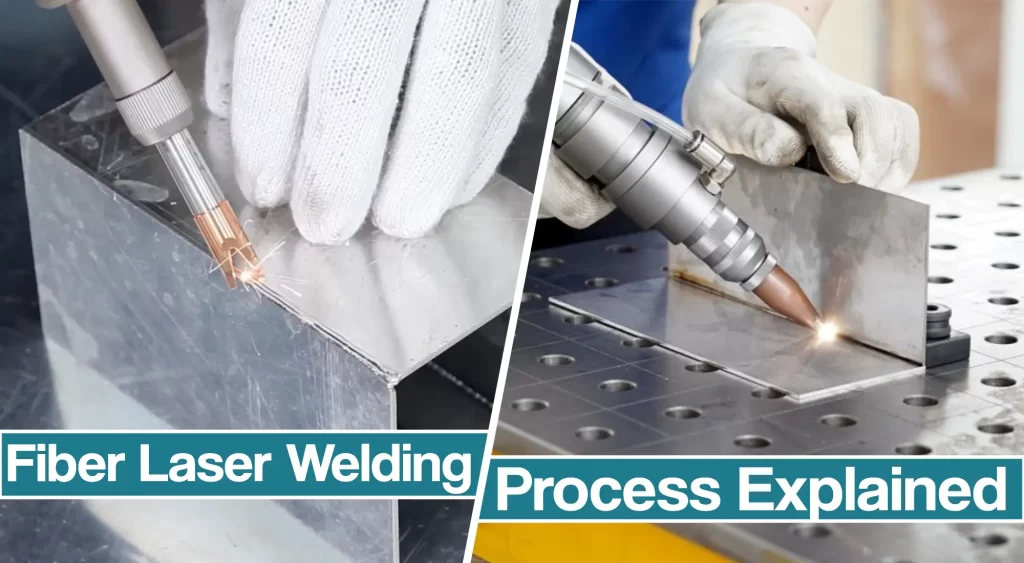
The high power densities available from fiber lasers are ideal for use in high-speed seam and penetration welding of steels, and also welding of more reflective materials, including copper.
The fiber laser also finds application for conduction welding, which occurs at much lower power densities and therefore with larger optical spot sizes. Additionally, using fine control over pulse widths and pulse frequency makes welding thin materials and tiny components possible.
Basics Of Fiber Laser Welding
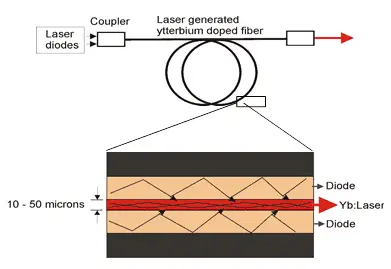
A fiber laser is produced inside a small core silicon fiber, typically between 9 and 50 microns in diameter, doped with Ytterbium, a rare-earth metal.
Since the laser forms within a fiber, there is no need to align the medium to cavity mirrors, nor to maintain optics and alignment, which is necessary with other laser types.
A unique feature of the fiber laser is its “focusability.”
For example, a 500-W laser can be focused to 10-micron spot size. For many welding processes, this would not a practical, but with effectively no lower limit on spot size, the fiber laser provides unique process parameter capabilities.
The fiber core medium can be pumped either by single emitter diodes that are spliced into the cladding surrounding the core, or by diode arrays launched into the cladding.
The fiber laser that works at 1,070 nanometers (nm) can be delivered to the welded metal using a flexible fiber optic cable. This lasing-fiber-to-focus-head-delivery-fiber connection can be made by direct splicing inside the laser or by using an external mechanical coupler.
However, the advantage of a mechanical coupler is that it allows easy replacement of the delivery fiber if damaged. On the other hand, if damage occurs with a typical spliced connection, usually the manufacturer needs to repair the laser, which can extend the time needed to get the job done.
Also, an external coupler may help in avoiding damage to the laser. When welding reflective materials like copper and aluminum, the back-reflections from the workpiece may damage the laser.
Fiber Laser Welding Machines Have a Low Cost of Ownership
Fiber lasers have an exceptionally low cost of ownership. The single-emitter option offers an estimated lifetime of 100,000 hours and the diode arrays are estimated to last about 50,000-100,000 hours.
To put this into perspective, 100,000 hours represents a “continually on” operational lifetime of approximately 11 years. However, even if you run a continuously running business, you are unlikely to use the laser 100% of the time.
To top that off, the fiber laser has an excellent electrical current use efficiency (around 30 percent), which reduces the need for the chiller (or the size of the chiller, if one is required), and also lowers your electrical bill.
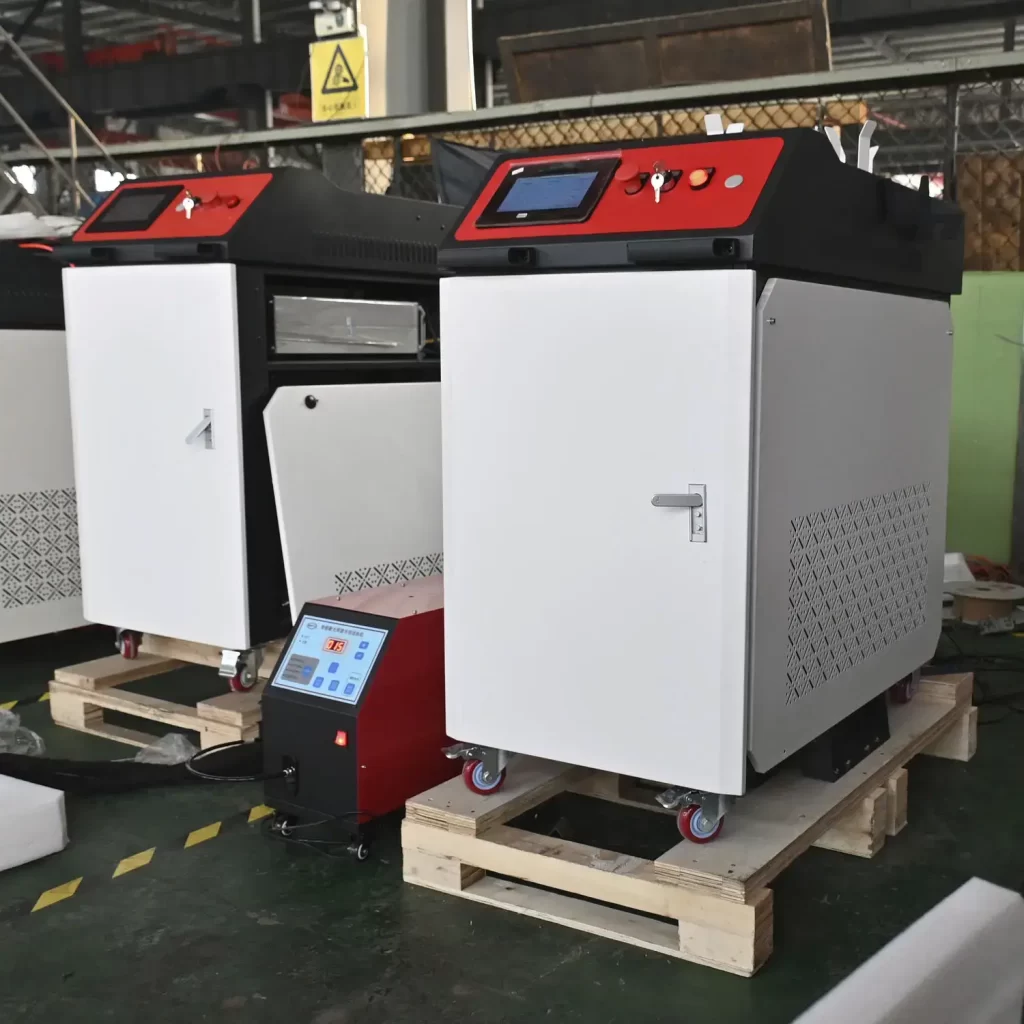
Plus, the fiber laser doesn’t have replaceable parts or consumables to worry about. However, we must warn you that fiber lasers are mostly non-repairable in the field. So if your laser does break, the unit would need to be repaired by the manufacturer.
Still, the maintenance costs are low and there are no internal consumables within the laser. Using fiber lasers in medical, automotive, electronic, and aerospace industries makes an excellent choice thanks to their high speed and welding flexibility.
Fiber Laser Beam Quality
The fiber laser offers the highest beam quality of any laser source. Essentially, fiber laser beam can be tuned to whatever is necessary for the given application.
Increased weld penetration and speed are directly responsible for better beam quality. However, weld stability and accommodation of manufacturing variances, for example, part placement and joint fit-up requirements, tend to favor lower beam quality.
You can always reduce the beam quality to match the application. But it is not possible to increase the quality of the laser once it exits the generator.
So, the key differentiator for the fiber laser is the maximum “tunable” range for beam quality. A particular process may use the optimal beam quality rather than a compromise selection made due to limits in laser welding technology.
Additionally, the high laser beam quality provides unique laser parameter features. For example, very small spot sizes of less than 0.0010-inch, or exceptionally high power densities serving more welding applications. A great example of fiber laser advanced use is the high-speed welding of thin copper sheets for battery applications. You can read more about welding batteries here.
The fiber laser technology is offered in two brightness modes: a single-mode, the highest brightness used mainly for cutting, and a multi-mode, principally used for welding.
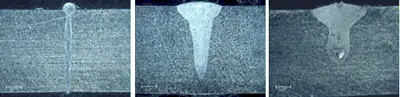
A large range in welding performance is possible in accordance with beam quality. However, the selection must be made from a standpoint of overall process reliability and not simply best penetration.
Micro Laser Welding
The fiber laser can be easily focused to a 0.001-inch spot size. So, it can produce sub 0.004-inch weld widths for extra small spot welds or high-speed lap geometry seam welds.
Normally, such applications require the power of around 200-500 W, depending on the necessary penetration and welding speed.
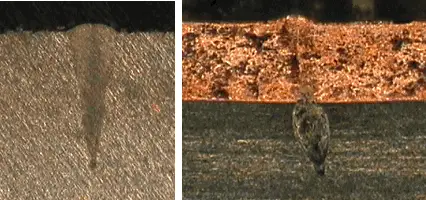
The weld aspect ratio (weld width/weld depth) can be tuned according to the application, thanks to high fiber laser pulse width.
Fiber lasers can also lap weld thin sheets of metal at exceptional speeds — up to 100 inches per second! Plus, this technology can weld copper, which is usually a difficult metal to laser weld because of its high surface reflectability.
The fiber laser’s high brightness overcomes this limitation since the high power density provides consistent absorption of the laser power. In addition the fiber laser welding process is stable because the high welding speed prevents overheating the metal.
However, you should know that the welding of copper in the sub-kilowatt range is possible only by a single-mode laser.
Conduction Welding
The fiber laser is used for many applications in high-speed conduction welding procedures.
The conduction welding using lasers occurs at much lower power densities and therefore larger optical spot sizes.
Conduction welding is exceptionally stable — there is no keyhole and no welding plume.
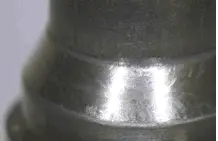
In addition, the larger spot size is less sensitive to part fit-up issues. This method can be very effective for barrier sealing requiring a penetration of 0.01-inch. As a result, the produced welds have a very smooth, highly appealing look.
Penetration Welding
Penetration welding means achieving penetration depths beyond 0.04-inch and often up to 0.25-inch thickness.
Fiber laser beam quality provides the most penetration depth per watt of laser power compared to other laser welding technologies, with even a 500-W laser capable of welding up to 0.08-inch thick.
Such a welding performance is achieved using a small spot size, around 0.003-inch.
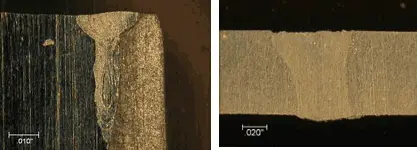
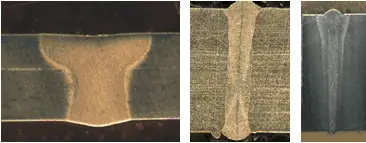
However, to employ fiber laser technology for penetration welding using a small spot size, the joint geometry requires either lap weld or a butt weld, with very high control of fit-up tolerances.
In most cases, it’s just not practical for manufacturing, so typical lasers range from 1 to 6 kW for almost all penetration welding needs.
Even if the particular process cannot take advantage of the fiber laser’s welding performance due to part fit and joint configuration, the fiber laser offers other benefits resulting in increased process stability and implementation flexibility.
The 1-micron wavelength of the fiber laser has much less effect on the weld plume compared to a CO2 laser, and so the necessary gas shielding for suppressing the welding plume is brought to a minimum, with low sensitivity to positioning relative to the weld.
Conclusion
The fiber laser welding process is a great choice for efficient welding of numerous materials for various applications. The provided high beam quality and single and multi modes make fiber laser one of the most versatile welding processes with exceptional flexibility. Additionally, the low cost of ownership and ongoing use are highly attractive. But, the caveat is that if something breaks, the manufacturer needs to fix it.